Tuesday, January 8, 2013

Dead as a Dodo.

Things do have a habit of becoming extinct, just think about the Dinosaurs and all the prehistoric life that went with them including many plants. Extinction is caused by one or many factors such as climate, disease, changes in sea level and of course asteroids. The sad fact is though that now we humans are fast tracking species extinction on a massive scale. By destroying habitats, pollution, over harvesting, global warming and illegal trafficking of species for profit. You can not just recreate a species from DNA and reintroduce it. Science is not able to do that yet and by the time it does, chances are that it will not have enough habitat left to live in. Wildlife parks are brilliant but animals very often need to travel vast distances to migrate or to simply keep their gene pool diverse. These parks are always running a war against poachers and the rarer the creature the higher the price on its head. A high price means people are willing to take bigger risks. Schools now cover rare species in their curriculum and my own son has been telling me all about the White Rhino he is studying in primary school. But let's go smaller and look pass the large mammals, endearing Pandas and fantastic Mountain Gorillas, lets look at the tiny invertebrates. At present one fifth of the world's invertebrates are at risk. That might not sound much until you realize that invertebrates make up around 80% of all animal life. They are the foundation of ecosystems all over the world. For us they recycle waste, pollinate, purify water and keep soils productive. We should do well to remember that.

The remains of mummified Dodos being preserved for science and to remind us that extinction is happening on a large scale in our lifetimes. Now caused by the impact of our species, not an asteroid.


Tuesday, January 1, 2013

Christmas crackers . . .

I would like to take this opportunity to wish you all a very merry Christmas and a happy New Year. 2012 has been yet another busy year with so many really fantastic school visits, brilliant media bookings and the chance to meet lots of great people. It has been fun to introduce so many people to the science of Entomology and to encourage loads of kids to see the world they live in from a different perspective. Enjoy your Christmas break and do not forget to get out there into the countryside to walk off the excess and marvel at natures raw beauty.


Tuesday, September 25, 2012

Science behind the scenes. . .

Recently I took a group of bug crazy children behind the scenes at the Oxford University Natural History Museum www.oum.ox.ac.uk/ to see for themselves the active entomological research going on behind the museums hidden doors. I do not want the children, who are mustard keen at the moment, to grow up thinking entomologists hide away in old dusty rooms smelling of moth balls!! This was a trip designed to make them understand what an entomologist does in the museum when they are not traveling to the far reaches of our planet in search of new species and discoveries. They met Darren Mann, the man who brings 'seriously cool' into entomology and who is also Assistant Curator and Collections Manager of the Hope Entomological Collections. He has had the honor of having many beetles named after him and is devoted to studying the scarab family. It was the most fantastic experience for the children! They learnt what happens to specimens after they are collected. How they are stored, maintained, identified, studied and labelled. They saw some of Charles Darwin's specimens and Dr. David Livingstone's famous tsetse fly as well as the awe inspiring site of the myriad of invertebrates from all over the world. They learnt how species identification can be time consuming work and how up to date technology is used. They even got the chance to help practically with some of the museums live invertebrate exhibits. The science of entomology became very alive for these children and each one went home inspired and enthused - mission accomplished, fabulous!
Drawers of full of surprises!


Using microscopy equipment.


Helping with an exhibit and choosing a treasure to take home as an memento of a very special day.




Make the most of Museums!

Museums have always held a fascination for this family and top of our list are Natural History Museums. So much to see, read, experience and learn. Museums are what you make them. Do not just sit there with a coffee and let your children wander around, experience each exhibit with them. Learn together! The collections you see are often unique and hold so much wonder. Encourage your children to stop and stare - if they can, to touch and feel. We learn through our senses the best. Do not forget to look at the buildings themselves. Natural history museums are often housed inside stunning buildings with a heady mix of ornate architecture and detailed decorations. Two of the many great museums to visit are the London Natural History Museum www.nhm.ac.uk/ and the Oxford University Museum of Natural History www.oum.ox.ac.uk/ . The OUMNH houses the Hope Entomological Collection and is an active invertebrate research centre. There is an extremely good permanent exhibit devoted to entomology as well as living displays and the opportunity to handle real live invertebrates. Have a superb family day out - go and immerse yourselves in a really awesome learning zone! Entrance is free but save a penny for a dinosaur cookie in the cafe overlooking the T-Rex exhibit. Hurry though, the OUMNH will be closed during 2013 for extensive roof repairs. When it reopens in 2014 it will be as fantastic as the day it hosted Charles Darwin's Great Debate in 1860!

Hands on sessions are always popular- a gorgeous Flat-rock Scorpion.


    Oxford University Natural History Museum.


Monday, September 24, 2012

Perfect Pinning. . .

Entomologists pin invertebrates to keep a record of the species they find and to enable other people to have a reference for study as pinned insects keep for a very long time indeed - Charles Darwin's pinned insects are still as good as new! Entomologists do not pin every insect they find, but a cross section of species they find on a single field trip. There are strict guide lines dictating the correct humane methods of killing invertebrates www.royensoc.co.uk/InvLink/Index.html They are instantly gassed in special 'killing jars' and mounted on boards only after the appropriate time. They must be laid out in such a way that the most entomological knowledge can be gained from them. The teaching of pinning methods is taken very seriously as live creatures are initially involved. When Bug Club children are taken on field trips they are expected to set traps, pin, identify, label their specimens and make notes on the habitat accordingly. It is very important that a child does not disrespect their duty to the humane killing of invertebrates for pinning and always approach this subject with true respect and concentration. When a habitats invertebrate life is examined, it is very similar to taking a 'blood sample' to assess the health of that environment. It is the small life that indicate any changes in the environment first as they are the greatest effected and otherwise unnoticed. They make up the important foundations of an entire ecosystem and must be studied to monitor our planets overall health as well as individual habitats.

True concentration is needed to prepare a specimen.


A carefully mounted dragonfly with its wings laid out under paper. When it is set the paper and extra pins will be removed.


Max Barclay (Curator and collections manager of Coleoptera and Hemiptera at the London Natural History Museum), teaches future young entomologists how to pin correctly.

Celebrating Entomology with Children!

The Amateur Entomological Society's (AES) Bug Club is a great club for bug mad children between 5 and 17 years old. Extremely reasonably price at a annual subscription of £12.00 per child. www.amentsoc.org/bugclub/ The Bug Club organizes loads of events throughout the year and they are all well attended. Its a great way to help your child meet like minded friends and build their confidence with lots of opportunities to produce exhibits, give talks and have articles published. The children are always delighted to see their work published in a magazine and you get to keep it forever (after showing the grandparents)! Amongst all the events on offer there is also the chance to go away on field trips. These are very exciting trips for the children as they include going out at night to check traps and see moths, pond dipping and pinning workshops. Expert and well known entomologists are a constant presence as are other suitably qualified and CRB checked adults. The knowledge and encouragement these children receive is exceptional. It is the sort of experience that will stay with them for life and they might even make life long friends!

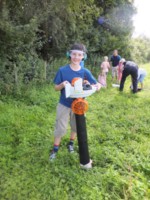
Using the bug hoover is always fun!
The next morning excitement of checking the moth traps!


Identifying small grassland species.

When its good to get muddy!


Tremendous Trade Fair!!

Get ready for the Amateur Entomological Society's (AES) Annual Exhibition and Trade Fair at Kempton Park Racecourse TW165AQ. Saturday 6th October 2012, 11am - 4.30pm. This is a fantastic entomological show to go to and the largest in the UK! There will be rows upon rows of traders and societies. It is open to everyone to attend - you do not need to be members- and at £4 per adult, £2 per child (under 7's free) pay on the gate, it is good value as a day out. There is simply so much to see, buy and learn on two levels of the exhibition building that you will be blown away! It is stuffed full of books, equipment, livestock, specimens and food plants. If your child is a member of the AES Bug Club they can enter a invertebrate based exhibit and with prize money on offer it is worth doing!! Come along and enjoy a tremendous day out meeting fellow enthusiasts and feasting your eyes on some of the worlds, as well as the UK's, amazing invertebrates! www.amentsoc.org/events/exhibitions.html

Learn about and admire invertebrates. Be inspired and meet like minded people at the AES Trade Fair 2012
Google Analytics Alternative